
U Visa Process in Connecticut: Requirements and Timeline (2026 Guide)
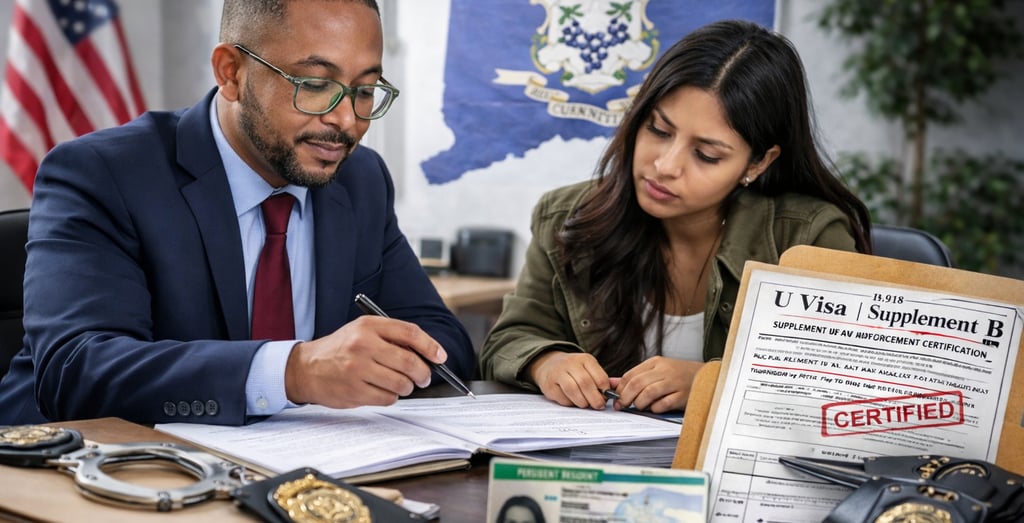

If you were the victim of a crime in Connecticut and helped law enforcement, you may qualify for a U Visa.
Many immigrants do not realize that the U Visa was created to protect victims — regardless of their current immigration status.
This guide explains the U Visa process in Connecticut, who qualifies, what documents are required, and how long the process may take.
What Is a U Visa?
A U Visa is a form of immigration protection for victims of certain crimes who have suffered substantial physical or emotional harm and have cooperated with law enforcement.
It was designed to:
Encourage victims to report crimes
Protect immigrants from deportation
Strengthen community safety
If approved, a U Visa can eventually lead to lawful permanent residence (a Green Card).
Who Qualifies for a U Visa in Connecticut?
To qualify, you must meet these requirements:
1. You Were a Victim of a Qualifying Crime
Qualifying crimes may include:
Domestic violence
Sexual assault
Felonious assault
Kidnapping
Human trafficking
Blackmail
Obstruction of justice
Witness tampering
The crime must have occurred in the United States or violated U.S. law.
2. You Suffered Substantial Harm
You must show that the crime caused significant physical or emotional harm.
This may include:
Medical records
Therapy reports
Police documentation
Personal declaration explaining the impact
Emotional trauma alone can qualify if properly documented.
3. You Helped Law Enforcement
This is one of the most important parts of the U Visa process.
You must have been:
Helpful
Currently helpful
Or likely to be helpful
A law enforcement agency must sign Form I-918 Supplement B (Certification of Helpfulness).
Without this certification, the case cannot move forward.
Step-by-Step U Visa Process in Connecticut
Step 1: Obtain Law Enforcement Certification
You or your attorney must request certification from:
Local police department
State police
Prosecutor’s office
Judge (in certain cases)
Not all agencies respond quickly, and some require formal written requests.
Step 2: Prepare and File Form I-918
The main petition includes:
Form I-918
Law enforcement certification (Supplement B)
Personal declaration
Evidence of harm
Supporting documents
Careful preparation is essential because USCIS reviews credibility closely.
Step 3: Apply for Work Authorization
Due to the annual cap of 10,000 U Visas per year, many applicants are placed on a waiting list.
However, once placed on the waiting list, applicants may qualify for:
Deferred action
Work authorization
This provides temporary protection while waiting for final approval.
How Long Does the U Visa Process Take in Connecticut?
Processing times are lengthy due to high demand.
General estimates:
Law enforcement certification: Several weeks to months
USCIS waiting list placement: 3–5 years (or longer)
Full U Visa approval: Often 5+ years
Every case is different. Proper documentation helps prevent delays.
What Happens After U Visa Approval?
If approved, you receive:
U Visa status valid for 4 years
Work authorization
Protection from deportation
After 3 years in U Visa status, you may apply for lawful permanent residence (Green Card), if eligible.
Can Family Members Apply?
Yes.
Certain family members may qualify as derivatives:
Spouse
Children
Parents (if victim is under 21)
Unmarried siblings under 18 (if victim is under 21)
Each situation must be carefully evaluated.
Why Hiring an Immigration Lawyer in Connecticut Matters
U Visa cases are complex and document-heavy.
An experienced immigration lawyer in Connecticut can:
Help obtain law enforcement certification
Prepare a strong personal declaration
Organize evidence properly
Address inadmissibility issues
Avoid costly filing mistakes
Because of long processing times, submitting a complete and well-prepared application is critical.
You May Have More Options Than You Think
If you were a victim of a crime in Connecticut, your immigration status does not automatically prevent you from seeking protection.
The U Visa exists to protect victims and strengthen communities.
If you would like to understand whether you qualify, speaking with an experienced immigration attorney in Connecticut can help you evaluate your options confidentially.